TL;DR
- When comparing AEO vs SEO, AEO targets citations inside AI-generated answers, while SEO targets traditional search results.
- Google AI Overviews now appear on roughly 60% of US searches as of April 2026, up from about 25% in late 2025 (SERPs.io, 2026).
- Pages with clear H2-H3-H4 heading structures get a 2.8x citation lift compared to unstructured pages (AirOps, 2026).
- Only 12% of AI citations overlap with a page’s ranking in Google’s top 10 results, so ranking #1 doesn’t guarantee an AI citation (Ahrefs Brand Radar, 2026).
- Google’s own May 2026 guidance describes AEO as part of SEO, not a separate discipline, so the two strategies should run together (Google, 2026, via Frase.io).
What Is AEO and How Does It Differ From SEO?
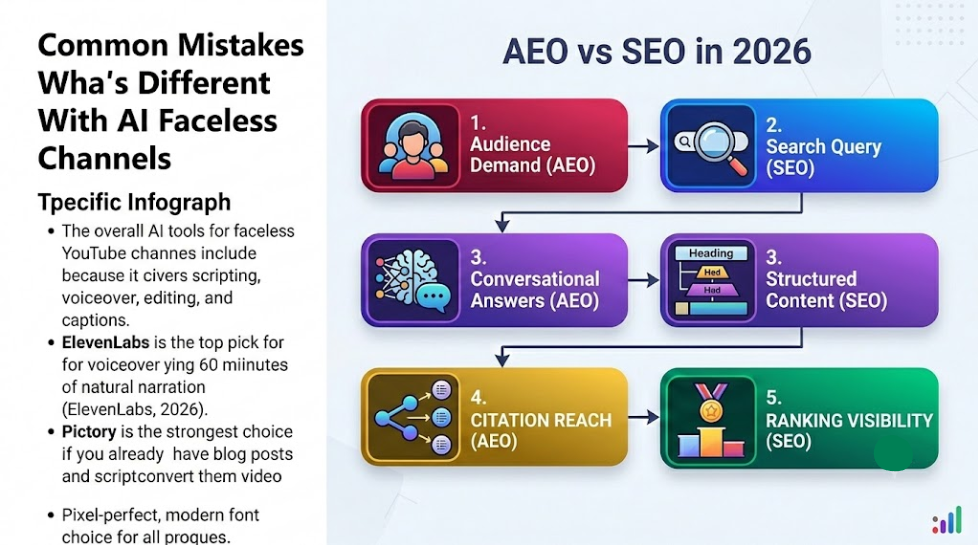
Answer Engine Optimization (AEO) is the practice of structuring content so AI tools like ChatGPT, Perplexity, Google AI Overviews, and Gemini can extract it and cite it directly in their answers. SEO (Search Engine Optimization) is the practice of ranking content in traditional search results so users click through to a website.
The two disciplines differ in three main ways:
- Goal: SEO aims for a high ranking position. AEO aims for a citation or mention inside an AI-generated answer, with or without a ranking.
- Success metric: SEO is measured by organic traffic, rankings, and click-through rate. AEO is measured by citation frequency and share of voice in AI responses.
- User outcome: SEO traffic lands a user on a results page with ten blue links to choose from. AEO traffic puts your information inside the answer itself, with your brand named as the source – or not named at all.
Both still rely on the same foundations: clear writing, topical depth, and credible sourcing. The difference is what happens to that content after it is published.
How AI Answer Engines Select and Cite Content
AI answer engines pull from multiple sources, synthesize them into a single response, and decide which sources to name. This selection runs on different signals than Google’s ranking algorithm, which is why AEO needs its own approach.
Three signals matter most based on 2026 research:
- Content freshness: 83% of AI citations for commercial and evaluation-stage queries come from pages updated within the past 12 months (AirOps, 2026). Pages left untouched for a full quarter are three times more likely to lose their citation status.
- Heading structure: Pages built with a clear H2 > H3 > H4 hierarchy get a 2.8x citation lift over pages without that structure (AirOps, 2026). This matches how AI systems break pages into chunks – each section needs to make sense on its own.
- Schema markup: FAQPage, HowTo, Article, Organization, and Author schema each add measurable lift to citation odds (AirOps, 2026). This only works when the schema reflects content that’s actually visible on the page – schema marking up hidden or implied content doesn’t help.
Why Ranking #1 Doesn’t Guarantee an AI Citation
A page ranking #1 in Google has no guarantee of appearing in an AI Overview or a ChatGPT answer. Research analyzing 15,000 prompts through Ahrefs Brand Radar measured how much AI citations overlap with Google’s top 10 results, platform by platform (Linehan and Guan, 2026):
- Overall overlap: Just 12% of AI citations match a page’s position in Google’s top 10 results across all platforms studied.
- ChatGPT: Overlap with Google and Bing results drops to 8%, the lowest of any platform measured.
- Perplexity: Shows the closest alignment to traditional rankings, at 28% overlap with Google and 14% with Bing.
- Google AI Overviews: The exception to the pattern, with 76% overlap between cited URLs and Google’s own organic results.
That last point matters for strategy. Google AI Overviews still lean heavily on Google’s organic index, so traditional SEO carries real weight there even as other platforms select sources through different signals.
What Changes When You Measure AEO Instead of SEO
Traditional SEO tracks rankings, organic traffic, and click-through rate. AEO requires a different set of metrics because a citation can influence a buyer without ever producing a click. Three metrics matter most:
- Citation frequency: How often AI tools reference your content as a source across a set of target queries.
- Share of voice: What percentage of AI-generated answers mention your brand compared to competitors answering the same questions.
- AI-referred conversion rate: How visitors who arrive via AI citations behave once they land on your site.
That third metric is where the gap shows up most clearly. Visitors who arrive via AI citations convert at 4.4 times the rate of standard organic visitors and spend 68% more time on site (Frase.io, 2026). These visitors tend to be further along in their research, since an AI tool already filtered and summarized information for them before they clicked.
Brands cited inside Google AI Overviews also see a knock-on effect on traditional clicks. Cited brands earn about 120% more organic clicks per impression than uncited brands competing for the same queries (Seer Interactive, 2026).
Common Mistakes When Treating AEO and SEO as Separate Strategies
Five mistakes show up most often when teams run AEO and SEO as if they were unrelated:
- Ignoring AI Overviews entirely: AI Overviews now appear on roughly 60% of US Google searches (SERPs.io, 2026). Skipping AEO means missing the placement most users see first, even if you are already using the cheapest unlimited graphic design service to make your standard landing pages look phenomenal.
- Writing for rankings only, not extraction: A page can rank #2 and never get cited if the answer is buried in paragraph four. Put the direct answer in the first two sentences of each section so AI systems can lift it cleanly.
- Letting content go stale: Pages untouched for a full quarter are three times more likely to lose AI citations (AirOps, 2026). Set a refresh schedule for any page targeting AEO.
- Adding schema that doesn’t match visible content: Schema markup only helps citation odds when it reflects what’s actually on the page (AirOps, 2026). Mismatched schema can get ignored or flagged.
- Measuring only clicks: Organic click-through rate on queries with AI Overviews dropped 61% between 2024 and 2025 (Seer Interactive, 2025). If clicks are the only metric tracked, a page can lose visibility in AI answers for months before anyone notices.
Frequently Asked Questions About AEO vs SEO
What is AEO in marketing?
AEO stands for Answer Engine Optimization. It’s the practice of structuring content so AI-powered tools like ChatGPT, Perplexity, and Google AI Overviews can extract and cite it directly when generating answers to user queries.
Is AEO replacing SEO?
No. Google’s May 2026 AI guidance describes AEO as part of SEO rather than a replacement (Google, 2026, via Frase.io). Traditional ranking signals still matter, especially for Google AI Overviews, where 76% of cited URLs overlap with top organic results (Linehan and Guan, 2026).
How is AEO different from SEO in practice?
SEO content is written to rank and earn clicks, with success measured through traffic and position in search results. AEO content is written to be extracted and cited inside an AI answer, with success measured through citation frequency and share of voice, even when no click occurs.
Do I need to write differently for AEO?
Yes, to a degree. Content that performs well in AEO follows three habits: it leads each section with a direct answer, it uses clear H2/H3/H4 headings, and it gets updated on a regular schedule. Pages with this structure get a 2.8x citation lift over unstructured pages (AirOps, 2026).
Which platforms should I optimize for first?
Start with Google AI Overviews, since they reach roughly 1.5 to 2 billion monthly users and have the highest overlap with traditional rankings at 76% (Search Engine Land, 2026; Linehan and Guan, 2026). Then expand to ChatGPT and Perplexity, which select sources using different signals and require separate tracking.
How do I measure AEO performance?
Track three numbers side by side: citation frequency (how often your content is referenced in AI answers to target queries), share of voice (the percentage of AI responses that mention your brand versus competitors), and the conversion rate of AI-referred visitors, since those visitors convert at 4.4 times the standard organic rate (Frase.io, 2026).
Key Takeaways
- AEO targets citations inside AI-generated answers; SEO targets rankings and clicks in traditional results. Both run on overlapping but distinct signals.
- Content freshness, clear heading hierarchy, and accurate schema are the three biggest levers for AI citation, according to AirOps’ 2026 research.
- Only 12% of AI citations overlap with a page’s Google top-10 ranking overall, though Google AI Overviews specifically show 76% overlap.
- Visitors arriving via AI citations convert at 4.4x the rate of standard organic visitors and spend 68% more time on site.
- Treat AEO as an extension of SEO, not a replacement – Google’s own 2026 guidance frames it that way.